Printer driver unavailable message state reference
A descriptive reference to the printer driver unavailable message, separating queue, connection, package, compatibility, and capability states.
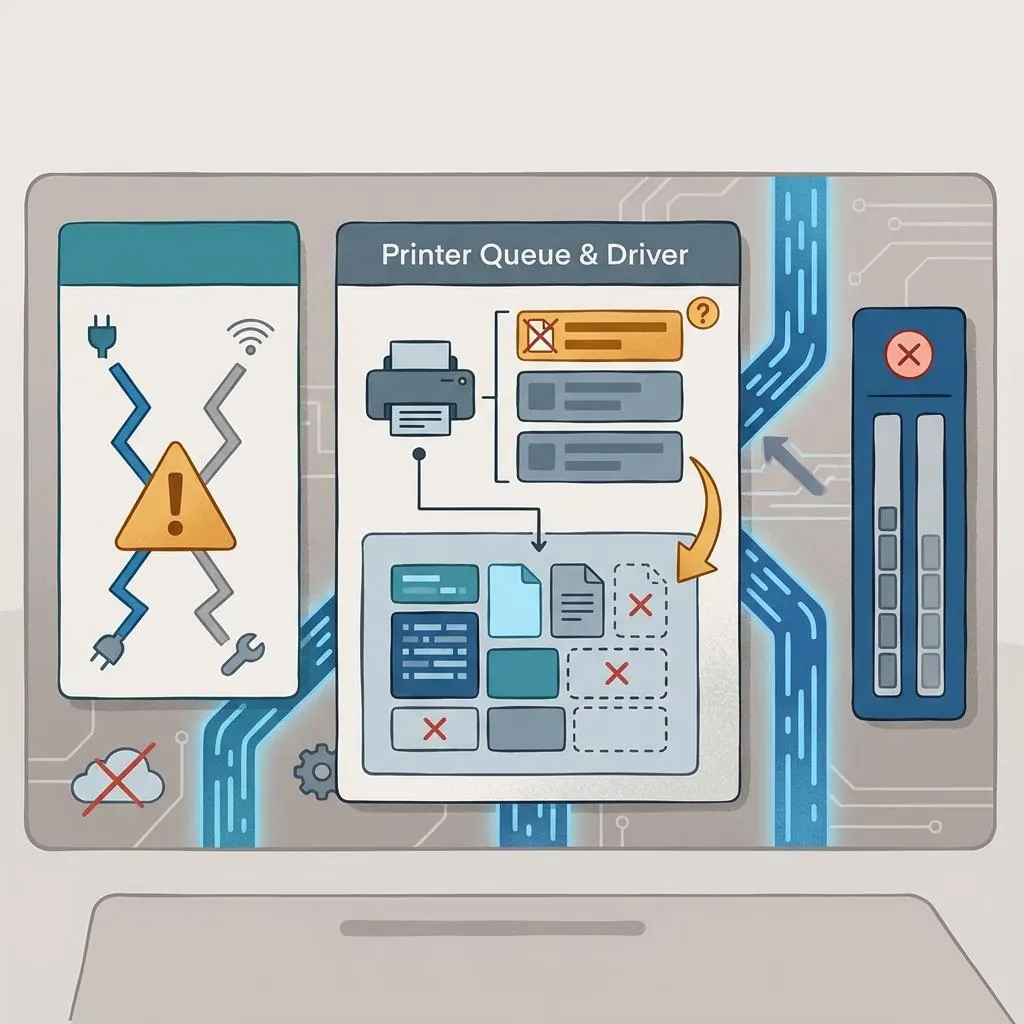
What the unavailable state names
A driver-unavailable message describes a failed relationship between a queue and the component it is expected to use. It does not, by itself, identify whether the package is missing, unsupported, damaged, disconnected, or assigned to the wrong queue. The emitting layer and the complete message are important parts of the state record.
Queue and port are separate evidence
A queue stores a host-side printer relationship, while a USB port, network address, or print protocol identifies a transport boundary. A queue can remain present after an address changes or a device is no longer reachable. That state can look like a package problem even when the package metadata is intact.
Compatibility is multi-dimensional
Model identity, package release, architecture, protocol, and declared capabilities all contribute to compatibility. A package for a neighboring model or another hardware context can appear plausible while leaving the queue without the expected features. “Unavailable” is therefore a state label, not a diagnosis.
Basic and extended representations
A standard or generic path may expose basic output while omitting vendor controls, scanner functions, media options, or status details. A vendor component may describe more capabilities but still depend on the correct queue and transport. Recording which representation is available prevents a partial interface from being treated as a complete failure or a complete match.
Reference facts
- State meaning
- The queue cannot use its assigned printer component
- Evidence layers
- Queue, port, package, platform, model, and capability metadata
- Important limit
- Unavailable is a relationship state, not a single cause
Questions and answers
Does driver unavailable mean the printer hardware is broken?
No. The message concerns the host queue and its assigned component. Power, transport, package, model, platform, and queue state can all influence the relationship.
Can a printer still produce output when a vendor driver is unavailable?
A standard or generic path may provide a narrower representation. That can support basic output while leaving vendor-specific capabilities outside the visible interface.